Across three summer REUs, I explored a range of research topics involving music, neuroscience, and human auditory processing.
Music Transcription (REU 1)
Automated music transcription is a challenging problem in computer science and signal processing. One effective way to analyze music is through its frequency content using the Fourier Transform, particularly the Fast Fourier Transform (FFT), which efficiently converts time-domain audio signals into their frequency-domain representations.
In this project, I recorded a set of instrument samples across various pitches to build a dictionary (or basis set) of FFT "components." Each component represents the frequency signature of a single note or pitch. Given an unknown frame of music, the goal was to decompose it into a linear combination of these known components.
This decomposition is expressed using the familiar linear model from linear algebra:
A = Mx + b
where:
Ais the observed frequency content of the audio frame (via FFT),Mis the matrix of known FFT components (each column corresponding to a pitch),xis a vector of weights (indicating the presence and strength of each pitch), andbis the residual error (ideally minimized).
Using least squares optimization, I estimated the vector x that best reconstructs the observed frame A. The components (i.e., notes) with the highest weights in x correspond to the notes being played at that moment in time.
This method was implemented and tested using MATLAB, with an emphasis on reconstructing musical phrases from synthetic and recorded instrument signals.
Transcranial Magnetic Stimulation (REU 2)
In university during the summer and part time throughout the year I contributed to research in Transcranial Magnetic Stimulation (TMS) in the Magnetics Laboratory at Iowa State University, under the guidance of Professor David C. Jiles.
My work largely involved the software calledSIM4Life, which is a specialized simulation platform used for bio-electromagnetic modeling, to simulate the interaction of magnetic coils with the human brain. These simulations incorporated high-resolution MRI data to analyze the spatial distribution of electric fields induced by various coil configurations.
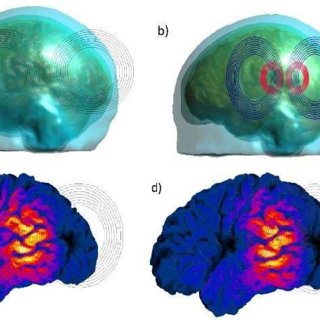
I automated the simulation workflows using Python scripts, enabling batch testing across various scenarios. The results were then analyzed and visualized using MATLAB to evaluate focality and strength of the fields — key metrics in the design of effective TMS coils.
Our research culminated in a peer-reviewed publication in IEEE: "Development of Focused Transcranial Magnetic Stimulation Coils for Treating Schizophrenia".
fMRI Auditory Processing (REU 3)
During this summer research experience, I studied the experimental design and analysis pipeline for functional Magnetic Resonance Imaging (fMRI). In simplified terms, fMRI captures brain activity as a 4D tensor, three spatial dimensions plus time, which reflects changes in blood-oxygen-level-dependent (BOLD) signals.
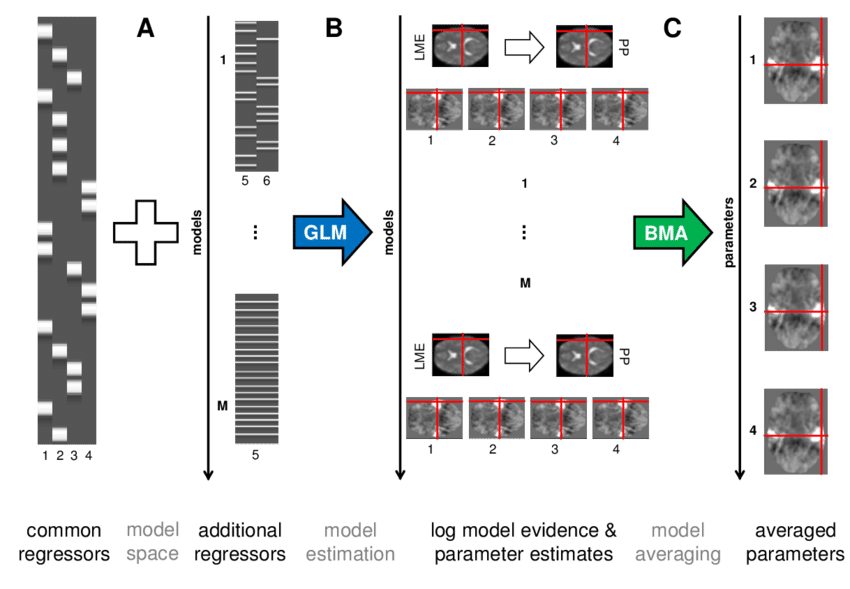
The core analysis involves correlating recorded brain activity with the experimental design, which includes time-stamped stimuli (such as auditory or visual cues) and subject responses (e.g., button presses) which are encoded in the "common regressors" matrix. These are aligned with hemodynamic response models to infer neural activation.
As shown in the diagram below, the fMRI pipeline incorporates both data preprocessing and statistical modeling:
My contributions included writing complex optimization scripts and parallelized processing routines in MATLAB to handle large-scale fMRI datasets from auditory perception experiments. This work required both numerical stability and computational efficiency to accurately model temporal-spatial correlations in brain responses.
← Back to portfolio